South Torrance is one of the most desirable residential areas in the South Bay region of Los Angeles County, known for its quiet streets, well-maintained neighborhoods, and proximity to the Pacific Ocean. Like all Southern California communities, South Torrance has specific environmental conditions that influence the performance and longevity of paved surfaces. Coastal salt air, marine layer humidity, UV intensity, and the occasional heavy winter rainfall create unique challenges for asphalt pavement. This guide provides a thorough understanding of asphalt paving in South Torrance covering what Asphalt contractor South Torrance is, how it is installed, what types of services are available, how the coastal environment affects pavement performance, and what maintenance practices extend the life of asphalt surfaces in this area.
What Is Asphalt Pavement?
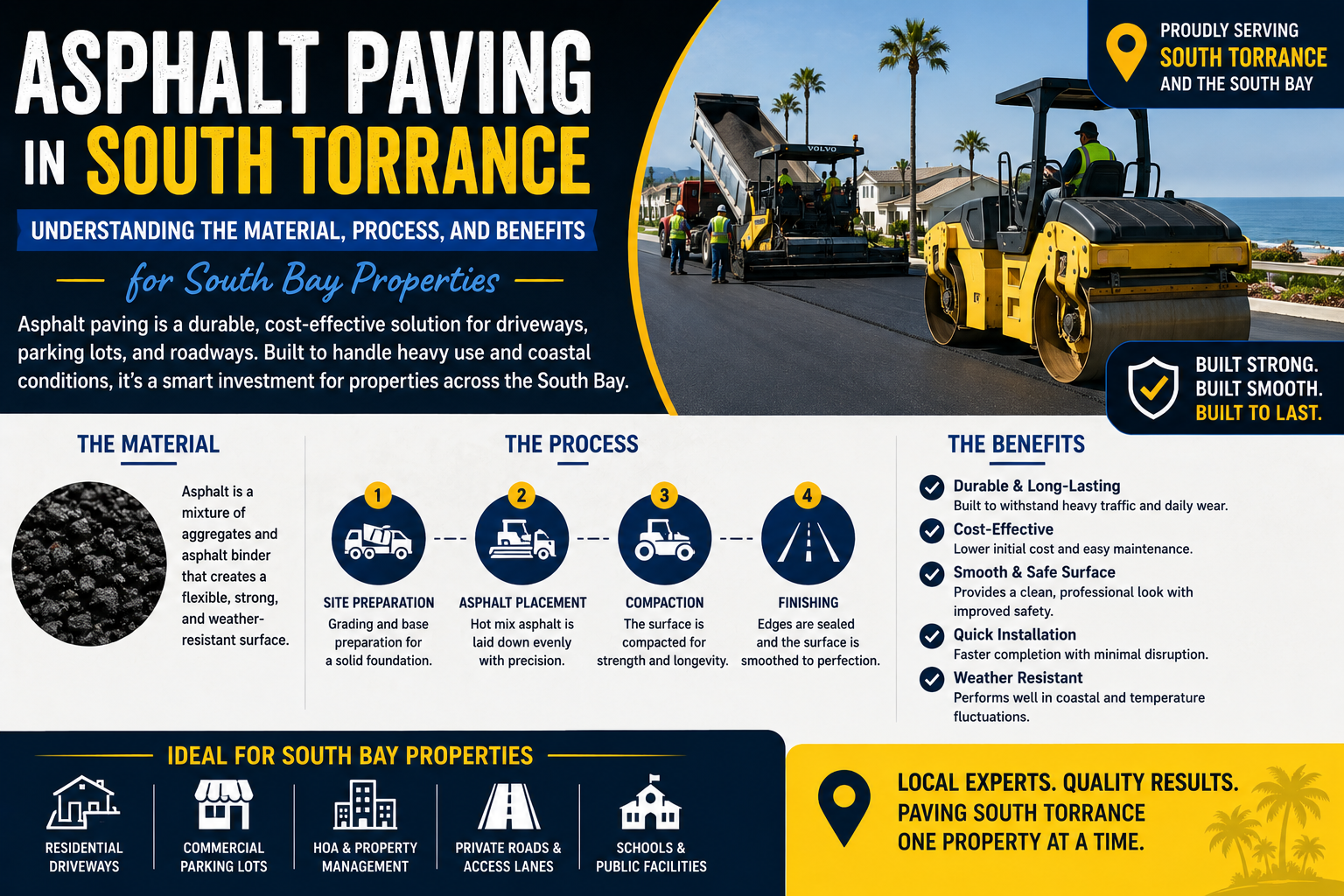
Asphalt also called bitumen or blacktop is a mixture of aggregates (gravel, sand, and crushed stone) bound together by a petroleum-based binder. The result is a flexible, dense material that distributes the weight of vehicles across its surface evenly, making it suitable for driveways, parking lots, roads, and pathways.
Unlike concrete, which is rigid and can crack under ground movement, asphalt is semi-flexible it can absorb minor shifts in the subgrade without fracturing. This quality makes it particularly valuable in Southern California, where clay soils expand and contract with moisture changes and occasional seismic activity can cause subtle ground movement.
Modern hot-mix asphalt is manufactured at high temperatures in batching plants. The mix is transported to the job site while still hot and laid using specialized paving machines that spread and level it uniformly before compaction.
Asphalt Services Available in South Torrance
Asphalt contractors serving South Torrance offer a range of services suited to both new installations and the maintenance of existing surfaces:
New Asphalt Installation: Complete installation of asphalt driveways, parking lots, private roads, and commercial surfaces. This includes site excavation, base preparation, and asphalt paving.
Asphalt Resurfacing (Overlay): A new layer of asphalt is applied over an existing surface that is structurally sound but showing surface deterioration. This is more economical than full removal and replacement.
Asphalt Removal and Replacement: When an existing surface is beyond resurfacing due to deep base failure, excessive cracking, or root intrusion the old asphalt is removed, the subbase is repaired or rebuilt, and new asphalt is installed.
Pothole Patching and Crack Repair: Targeted repairs to localized areas of damage. Crack filling and patching prevent water from penetrating the surface and reaching the subbase, where it can cause significantly greater damage.
Sealcoating: A protective emulsion is applied to the surface of asphalt to shield it from UV oxidation, water intrusion, oil spills, and general wear. Sealcoating is recommended every two to three years and is one of the most cost-effective maintenance investments for asphalt surfaces.
Parking Lot Striping: Line marking for parking stalls, fire lanes, directional arrows, handicap spaces, and other pavement markings. Striping must meet ADA requirements for handicapped accessible spaces.
Grading and Drainage: Establishing proper surface grades so water drains effectively away from buildings and structures, preventing ponding and subbase erosion.
How the South Torrance Coastal Environment Affects Asphalt
South Torrance’s location adjacent to the Pacific Ocean creates a set of environmental conditions that differ from inland Southern California communities:
Marine Layer and Moisture: The marine layer the layer of cool, moist air that flows inland from the ocean keeps South Torrance cooler and more humid than cities further east. While this is pleasant for residents, moisture cycles can accelerate deterioration of unprotected asphalt by penetrating surface cracks and weakening the subbase over time.
Salt Air: Proximity to the ocean means that asphalt surfaces are exposed to airborne salt particles. While asphalt is generally tolerant of saline environments, salt can accelerate the oxidation and hardening of the bitumen binder, particularly on older surfaces. Sealcoating helps protect against this.
UV Radiation: Even with the coastal marine layer, South Torrance receives significant UV exposure. UV radiation breaks down the hydrocarbon chains in the asphalt binder, causing the surface to fade from black to gray and become brittle over time. Regular sealcoating with UV-protective formulations is the standard mitigation.
Temperature Range: South Torrance’s coastal location moderates temperature extremes compared to inland areas. This more temperate climate actually benefits asphalt pavement by reducing the degree of thermal expansion and contraction that can stress pavement over time. New asphalt installed in South Torrance has an expected service life of 15 to 20 years with proper maintenance.
Winter Rainfall: Seasonal rain is the primary water management challenge for South Torrance paving. Properly graded surfaces drain water efficiently, preventing it from pooling and infiltrating pavement edges and base layers. Drainage considerations are an integral part of any quality asphalt installation in South Torrance.
The Asphalt Installation Process in South Torrance
A quality asphalt installation in South Torrance follows a defined sequence of steps that ensures long-term performance:
Site Assessment: Before work begins, the contractor evaluates the area, including soil conditions, drainage patterns, existing pavement condition (if any), access constraints, and grading requirements.
Excavation and Subgrade Preparation: Old surfaces are removed if necessary, and the subgrade the native soil beneath is excavated to the appropriate depth. Unstable or organic material is removed and replaced with suitable fill.
Aggregate Base Installation: A layer of compacted crushed aggregate is placed over the subgrade. This base distributes the load from vehicles across a broader area and provides a stable, well-draining foundation for the asphalt above.
Asphalt Paving: Hot-mix asphalt is delivered and spread using a paving machine to a uniform thickness. For residential driveways, a finished thickness of two to four inches is common. Commercial and high-traffic areas require greater thickness.
Compaction: After the asphalt is spread, rollers compact it to eliminate air voids and create the dense, smooth surface characteristic of quality asphalt pavement.
Edging and Finishing: The edges of the paved area are defined and finished. Proper edge treatment prevents the asphalt from raveling from the perimeter inward over time.
Asphalt Maintenance Practices for South Torrance Properties
The longevity of asphalt pavement in South Torrance is directly tied to the quality of ongoing maintenance. The following practices are recommended for property owners:
Regular Inspections: At least once a year, walk the asphalt surface and look for developing cracks, edge deterioration, or drainage issues. Early identification of minor problems prevents them from becoming major ones.
Crack Filling: Small cracks should be filled promptly using asphalt crack filler. Cracks left unaddressed allow water to reach the base layers, where it undermines the structural integrity of the pavement.
Pothole Repair: Potholes form when water penetrates and weakens the base, causing the surface to collapse under traffic loads. Prompt pothole repair prevents the damaged area from expanding.
Sealcoating: Applied on a two-to-three-year cycle, sealcoating replenishes the binders that UV radiation and oxidation degrade, restoring the surface’s dark color and protective properties.
Drainage Maintenance: Keep drains, gutters, and swales clear of debris. Standing water on or adjacent to asphalt surfaces is one of the primary causes of premature failure.
Avoiding Chemical Exposure: Vehicle fluids, particularly oil and gasoline, break down the asphalt binder when they accumulate on the surface. Addressing oil drips promptly and keeping the surface clean extends pavement life.
Residential vs. Commercial Asphalt in South Torrance
The asphalt needs of South Torrance residents and businesses differ in scale and specification:
Residential Applications: Private driveways, pathways, and small parking areas are the most common residential asphalt projects. A well-installed residential driveway can last 20 years or more with proper sealcoating and crack maintenance. The South Bay real estate market means that driveway appearance contributes meaningfully to property curb appeal and value.
Commercial Applications: Businesses in South Torrance from retail centers and restaurants to industrial facilities require parking lots that handle higher traffic volumes, heavier vehicles, and intensive daily use. Commercial asphalt specifications typically call for greater thickness and higher-strength base layers. ADA compliance is also mandatory for commercial parking facilities, requiring properly placed and dimensioned handicapped parking spaces.
HOA and Multi-Family Properties: Homeowners associations and multi-family property managers in South Torrance are responsible for maintaining shared driveways, parking areas, and private roads. Scheduled maintenance programs including annual inspections, periodic crack sealing, and sealcoating on a regular cycle represent a cost-effective approach to managing this shared infrastructure.
Frequently Asked Questions About Asphalt Contracting in South Torrance
How long before I can drive on new asphalt? New asphalt should generally be kept free of vehicle traffic for 24 to 48 hours after installation. Full cure and hardness develops over the following weeks, particularly in warm weather.
Does asphalt hold up near the ocean? Yes. With proper installation and regular sealcoating, asphalt performs well in coastal environments like South Torrance. The moderate temperatures of the coastal climate are actually favorable for asphalt longevity.
When is the best time to pave in South Torrance? Asphalt can be installed year-round in Southern California, but warm, dry conditions typical of late spring through fall are optimal. Rain can interrupt a paving project and should not fall on fresh asphalt before it has had time to set.
What causes asphalt to crack? Cracking results from traffic loads, UV oxidation of the binder, thermal cycling, water infiltration, and subbase deterioration. Regular maintenance significantly slows the progression of cracking.
Conclusion
Asphalt paving in South Torrance is both a practical investment and an aesthetic asset for residential and commercial properties throughout the South Bay. Understanding how the material works, how it is installed, how the coastal environment affects its performance, and what maintenance practices extend its life empowers property owners to protect their paving investment.